Old Dutch Foods
Slipstick® Sanitary Horizontal Motion Conveyor Food Grade Conveying Equipment
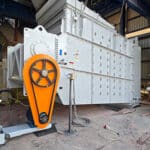
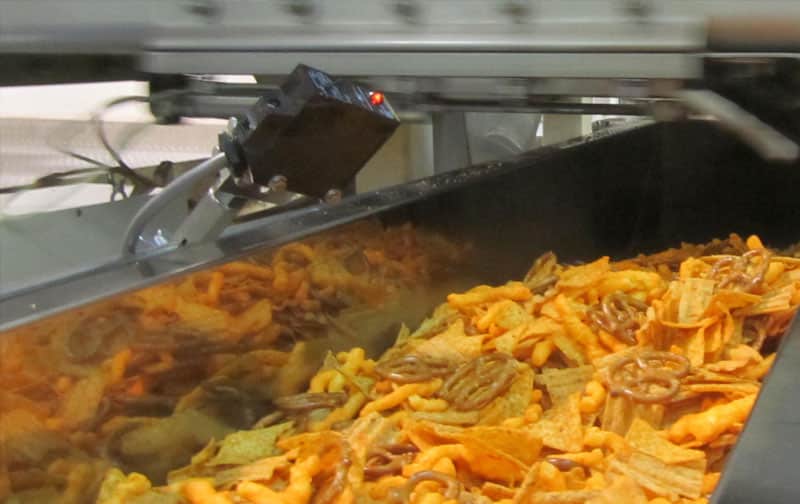
The Slipstick Sanitary Conveyor, the first horizontal motion conveyor, is the food industry standard, recognized for its gentle, non-impact conveying motion and enviable record of low maintenance, high reliability and performance. Maintaining food safety and quality is the primary benefit of using the Slipstick in food processing applications. Unlike conventional vibrating conveyors that use a vertical pitching motion to propel material with repeated impacts which can cause the food to break or stick, the Slipstick’s single-drive mechanism provides a unique motion that glides the product down the pan, eliminating breakage problems for fragile foods such as chips, cookies, or cereal.

Free E-Book
Download our new E-Book to learn how to choose the proper vibratory conveyor!
Download the E-BookSanitary Vibratory Conveyor Systems
Food grade conveying systems for fragile food, snack food, and pet food / treats.
- Discourages build-up of materials on the surface
- Typically scours the pan clean so there’s less time required between production cycles for cleaning
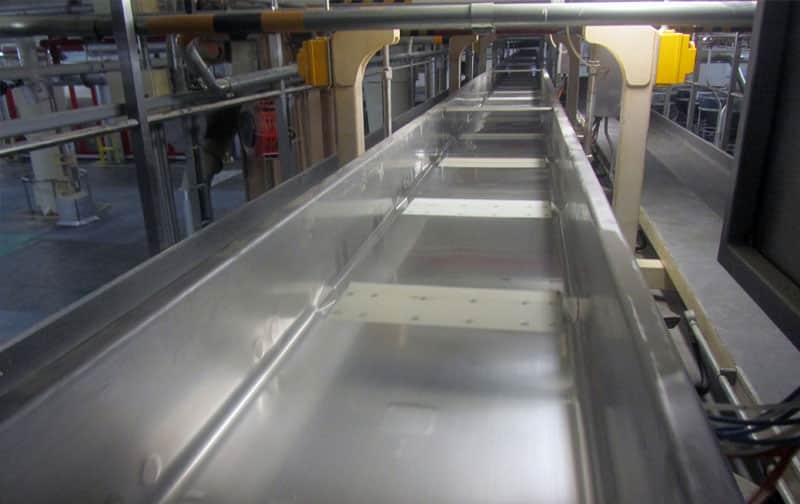
- Exterior surfaces of the conveyor can be easily accessed for wipe down cleaning
- Cleaning under the conveyor is easier because typically there are no support frames or springs
- Mechanical simplicity over screws or drag conveyors.
- Requires significantly less maintenance.
- Safer conveying with no chains, screws, sprockets, rollers, idlers, or other moving parts located outside of the sealed and guarded drive unit
- Form / Function for Vibratory Conveyors
- Vibratory Conveyor Configurations
- Accumulation
- Food Grade Applications
Form / Function for Vibratory Conveyors
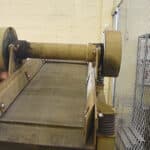
The key to horizontal motion conveying is the action of the conveyor upon the inertia of the conveyed materials. During the slow advance of the conveyor’s cycle, material is at a relative rest on the conveying surface. The quick return segment of the cycle gently slides the conveying surface under the material bed. Repeating this cycle 200 – 300 times per minute serves to smoothly convey the material up to forty feet per minute along the length of the conveying surface. Benefits of this motion include:
- Discourages build-up of materials on the surface
- Typically scours the pan clean so there’s less time required between production cycles for cleaning
- Exterior surfaces of the conveyor can be easily accessed for wipe down cleaning
- Cleaning under the conveyor is easier because typically there are no support frames or springs
- Mechanical simplicity over screws or drag conveyors.
- Requires significantly less maintenance.
- Safer conveying with no chains, screws, sprockets, rollers, idlers, or other moving parts located outside of the sealed and guarded drive unit
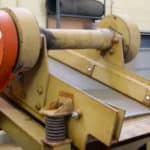
Based on its unique design that features a self-contained drive unit that has no outbound moving parts, the horizontal motion conveyor is virtually maintenance-free. Compared to conventional vibrating conveyors, powered by springs and convey material through impact on the conveyed material, the horizontal motion conveyor provides gentle transportation. And based on its relatively slow rotational speed, a typical drive unit will usually deliver more than ten years of life between service intervals, with only periodic lubrication required. Finally, since these conveyors utilize no springs or counterweights, they do not require the periodic tuning that is part of an ongoing maintenance program for conventional vibrating systems.
For materials that require transportation without compaction or segregation, the horizontal motion conveyor provides an ideal system. The “en masse” conveying method provided by the horizontal motion assures that mixtures will be delivered as originally blended, and fine particles will remain evenly distributed throughout the entire product bed – meaning retention of seasonings, coatings and breadings; prevention of oily fines build-up; and elimination of food product segregation.
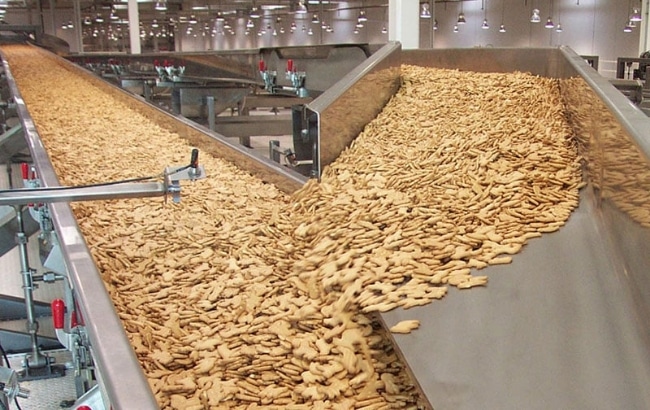
Vibratory Conveyor Configurations
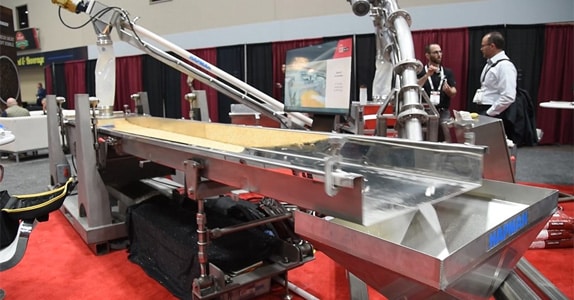
Built in lengths from 4 ft. to more than 200 ft., the Slipstick offers a variable rate of product delivery depending upon the application, and is adjustable to suit most any requirement. Base mounted on the floor or suspended overhead, horizontal motion conveyors provide the level of versatility required for difficult installation applications. Conveyor drives may be positioned at either end of the conveyor, or mounted above or below. In addition, these conveyors can be operated at variable speeds, and their conveying direction is reversible. Conveying surfaces may be carbon, stainless, or abrasion resistant steel, as well as polyethylene plastic, or titanium.
The Slipstick can be suspended from overhead to maximize the use of valuable floor space or built with floor-mounted pedestals. Because it is dynamically self-balancing, no counterweights or heavy isolation bases are necessary. The drive module is mounted at either end or above or below the conveyor’s pan section.
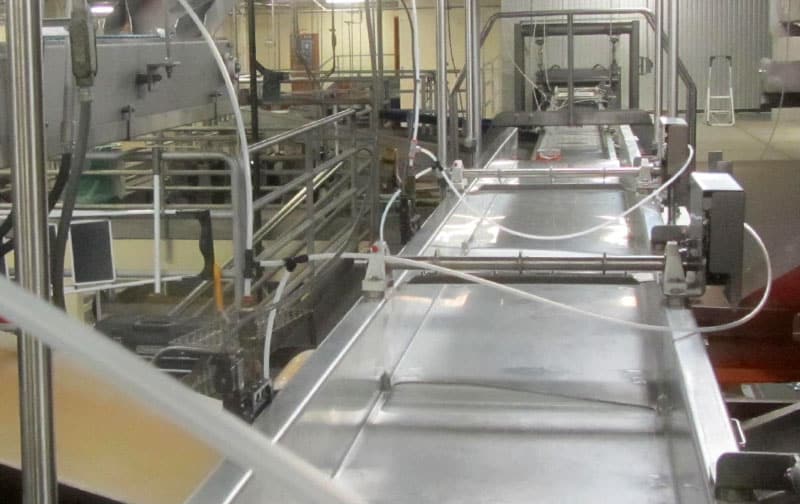
Pan options for the Slipstick include multiple channels, pneumatically actuated discharge gates, and removable covers. Sealed tube sections provide added product protection and allow for CIP. The Slipstick can also be configured to align, singulate, divide, dry, or cool product as it flows through the conveyor.
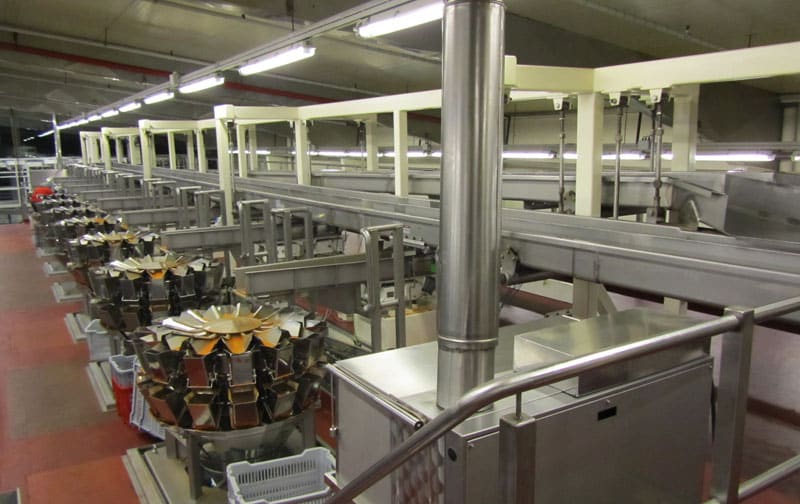
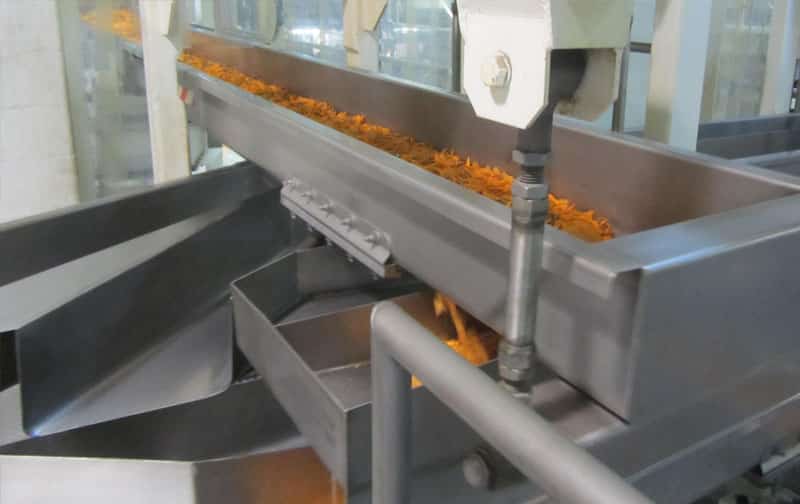
Accumulation
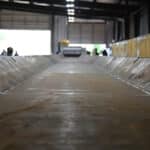
The Slipstick is a clear choice for in-line storage of many products. The one-piece seamless conveyor pan eliminates cracks, crevices and moving parts in the product stream. No carry-over from seasonings, coatings or powder residue to add to normal plant house-keeping tasks. This feature offers quick and thorough clean-out for enhanced sanitation and a greatly reduced risk of any cross contamination between product runs.
The gentle horizontal motion of the conveyor is uniquely suited for the storage and discharge of the most fragile products. There is no product stratification and it can be a sealed system if required, as well as controlled discharge or retention times of the stored product. By reducing the speed of the conveyor, the slower product travel rate will allow the product bed depth to build up within the conveyor trough. Accumulator product depth can be further increased by the use of stationary product dams positioned along the length of the conveyor behind. The gentle horizontal motion of the Slipstick Accumulator allows the product to build depth behind a pneumatically controlled stationary product dam without product damaging impact against the dam.
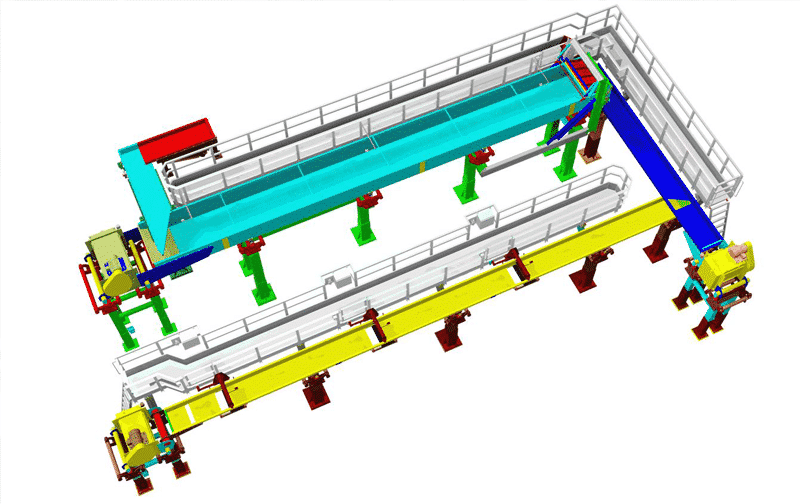
Product storage can be accomplished with the Accumulator style storage (greater product depths for shorter storage areas) with metered discharge options, long shallower bed depth conveyors that are regulated with conveyor speeds and the Slipstick loop system that consist of 2 conveyors in a parallel, circular product loop where product is bled off using singular or multiple gating options.
- Slipstick Accumulators can be equipped with pneumatically actuated product dams and level sensors to meter product to downstream equipment.
- Slipstick accumulating conveyors have been provided with storage capacities from as little as 20 cubic feet to over 1000 cubic feet. Capacities beyond these volumes are possible with the Slipstick Accumulator.
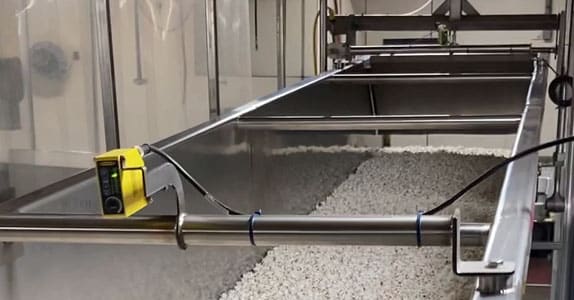
The system may be monitored by level sensors positioned above the product bed that can activate product dam position or to vary the speed of the conveyor for bed depth and discharge rate control. Another approach is the use of a distribution Slipstick conveyor mounted above the length of the accumulator equipped with closely spaced discharged gates that are actuated by level sensors positioned along the length of the conveyor. These are positioned to build product depth with a gentle product-on-product drop in order to build the maximum bed depth for large storage capacity requirements.
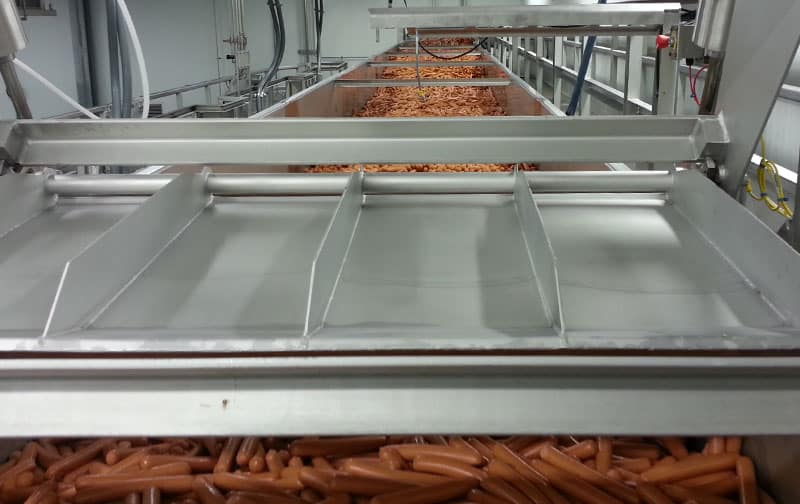
Food Grade Applications
Based on its many advantages over conventional conveyors, the Slipstick is currently being utilized conveying hundreds of different food products, including:
- Almonds
- Bacon
- Beans
- Candies
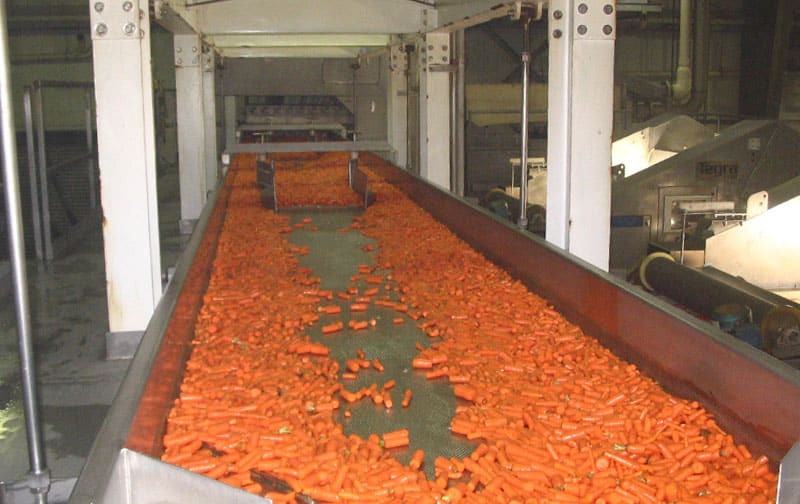
- Carrots
- Cereal
- Cinnamon
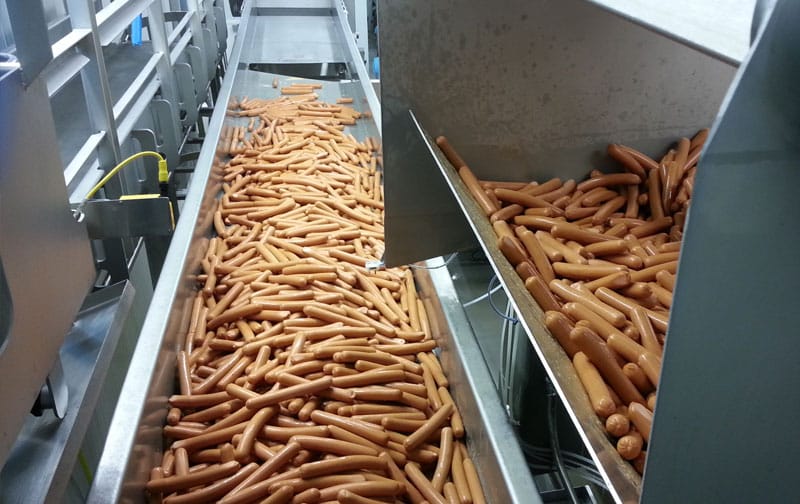
- Cocktail Sausages
- Cheese Snacks
- Chocolate Chips
- Cocoa Beans
- Coffee
- Cookies
- Corn Based Chips
- Crackers
- Grapes
- Marshmallows
- Milk Products (dry infant formula)
- Onion Rings
- Pasta
- Peanuts
- Pet Food/Treats
- Popcorn
- Pork Rinds
- Potato Chips
- Pretzels
- Raisins
- Shredded Cheese
- Trail Mix
- Wieners
Options
- Materials of Construction
- Impact liners
- Dual direction
- Supports
- Product dams
- Multi-lane
- Textured pans
- Chutes
- Flow Inhibitors
- Platforms
- Non-metallic sections
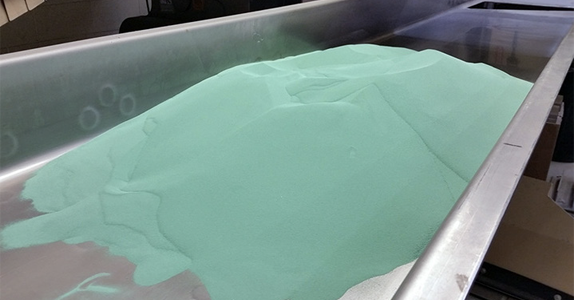
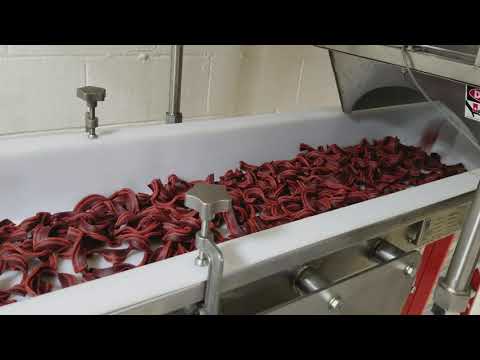
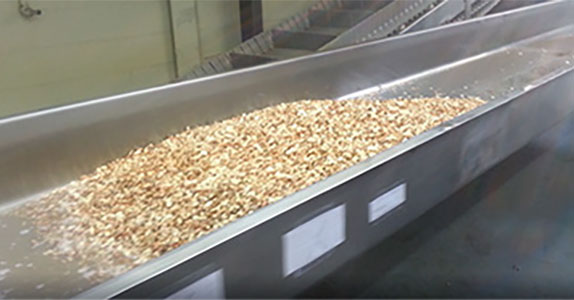
Slipstick Sanitary Applications

Slipstick Vibratory Conveyors FAQ
Can these types of conveyors transport goods at an incline?
While most applications are horizontal, some are required to transport at an incline or a decline. It is possible to move products up very shallow angles using differential motion. The material/object physical characteristics will determine the practical incline. Different product shapes will convey better up inclines than others. Round or spherical product shapes tend to lose the conveying energy through rolling during the end of a product run. Product cleanout of the conveyor pan may also be an issue; however, pan cleaning devices can be introduced to help remove any remaining product pieces in the conveyor pan at the end of the production run. The product travel rate and resulting conveyor capacity will also be lower when conveying products uphill. This lower capacity may be compensated for by increasing the conveyor operating stroke or the pan width.
Can these conveyors be easily cleaned?
With cleaning and sanitation issues being of utmost importance to many processors, this question comes up a lot. The typical horizontal motion conveyor consists of a one-piece formed trough (or pan) section with suspension points spaced periodically along the conveyor pan length. This allows both the interior and exterior surfaces of the conveyor pan to be easily accessed for wipe down cleaning. There are typically no support frames or springs under the conveyor to clean, which introduces cracks and crevices that are very difficult to clean. The gliding of the product along the seamless one-piece formed conveyor pan discourages build-up of materials on the surface. The continuous sliding action on the conveyor’s surface typically scours the pan clean so there’s less time required between production cycles for cleaning.
This type of conveyor can also be totally enclosed in either a rectangular or tubular shape and can be equipped with a CIP (clean-in-place) system. This type of unit employs CIP nozzles located along the length of the conveyor tube so the processor can wet-wash the conveyor interior between product runs.
Can these conveyors handle a head load / full hopper?
Yes. Very large or heavy loads can be discharged this way in a properly designed system. The horizontal motion conveyor has tremendous load carrying ability, with some units able to convey two to three times their own empty weight.
And because it is not a “tuned” system, the horizontal motion conveyor can be operated at variable speeds for control of the material travel rate. These conveyors are not “de-tuned” by typical increases in material loading on the pan of the conveyor.
Will these types of conveyors meter product?
When arranged with a full hopper, the conveyor will vary its discharge rate according to the motor speed. The ability of the differential motion conveyor to convey deep product bed loads allows it to be used as a self-discharging storage unit.
The differential motion conveyor can also be equipped to provide for product aligning, singulating or product de-shingling. A food processor making chocolate covered pretzels had to use several line workers to manually align and de-shingle product downstream from a regular vibratory conveyor that was shingling the pretzels due to the vertical pitching motion. When a horizontal motion conveyor was installed equipped with aligning lanes and special de-shingling ramps, the processor increased productivity and reduced the required manual labor by significantly reducing the number of shingled pretzels that resulted in scrap, therefore increasing line yields and reducing labor costs.
Also, the conveyor pan discharge can be equipped with pneumatically actuated product dams or manually adjustable flow baffles to accumulate and meter product to other downstream equipment. Product degradation is not an issue when using product dams or flow baffles because of the gentle horizontal conveying motion which allows products like snack foods, breakfast cereals or hot dogs to be accumulated up to several feet deep.
Can there be a change in directional flow in this type of conveyor?
A differential motion conveyor can be made to convey in either direction (but only one at a time) when configured correctly. The conveying direction can be reversed by reversing the drive motor’s voltage polarity through the motor’s starter. Reversing product direction can be useful in many applications, such as introducing material onto the differential conveyor’s midsection to be conveyed to a destination at one end of the conveyor and, when the conveying direction is reversed, to a destination at the conveyors opposite end. The differential motion conveyors drive can also be equipped with an optional online reversing mechanism that allows instantaneous product flow reversal for application such as filling bulk off stations.
Can these types of conveyors be totally sealed?
The unique conveying action of this type of conveyor will allow the use of either mated sliding surfaces between conveyors or the use of the standard flexible boot type inlet/outlet connections. A tube type conveyor allows a sealed and separate chamber open to the upstream and downstream process. The conveying section can be a fabricated trough or enclosed tube. If you must isolate your material from your plant environment, whether it is to control dust, provide pressure isolation, blanket the material with an inert gas, or to provide other environmental controls, you can select a totally enclosed tube. One or more feed inlets can be located anywhere along the conveying sections length; each is typically sealed with a flexible boot to control dust. Cleanout ports can also be added along the length of the conveyor.
What if multiple inlets and discharges are required?
More than one inlet and discharge can be incorporated into a single conveyor. The discharges can be a preset ratio of flow, variable discharge amounts or an “all or none” to different discharges. It is also possible to create an inventory of material before each discharge for an immediate delivery during demand.
One or more discharge outlets can be located at any of the various points along the conveying section’s bottom to distribute the material. Each outlet can be fitted with a mechanical discharge gate to start and stop material discharge. These gates, typically pneumatically actuated, can be a sliding style gate, butterfly valve or tip style drop gate.
Multiple inlets can be used to introduce product from different storage devices or to meter in a mixture of materials into one conveyor. This type of conveyor will not stratify or blend these materials to ensure a uniform discharge.
Multiple lanes can also allow different products/materials to be conveyed using the same conveyor pan and a single drive unit. Products will remain separated on the conveyor. In a recent application, several sizes of the same type of products were run in the single conveyor pan.
Will abrasive materials convey on the differential motion conveyor?
By the same nature of gentle handling of fragile products, tough/hard or abrasive materials do not impact or wear the conveyor pan surfaces at high rates. The differential motion of the conveyor does not press the material into the pan, forcing a gouging action that will wear the pan surface faster unlike vibrating conveyors. Abrasive wear is two to four times less than a conventional vibratory conveyor.
Recently, an industrial minerals producer had an application handling abrasive construction sand. Their major concerns were dust control and downtime due to regular vibratory conveyor maintenance because of the abrasiveness of the product. A differential motion conveyor was designed with BHN 400 abrasion resistant conveying troughs, fully enclosed with integral dust covers. This conveyor showed an average surface wear of just 0.010 inches after 14 months of operation. Dust emissions were eliminated and the only maintenance required is periodic lubrication.
In another abrasive application, a ceramic parts producer had a different problem. The dust generated from a cutting process was causing their existing belt conveyor bearings to fail quickly. Access to the bearings which ran the length of the belt conveyor was difficult and cumbersome. When this belt conveyor was replaced with a differential motion conveyor, with the drive unit at one end, moving parts of the unit were not exposed to the dust loading and are now more easily serviced at normal maintenance intervals.
If the conveyed materials are corrosive in nature, like chlorinated bleach powder, a titanium conveying trough may be one solution.
Can moist or sticky products be conveyed on the differential motion conveyor?
If the material to be conveyed is sticky, like dishwashing detergent, a conveying trough made of ultrahigh-molecular-weight polyethylene (UHMW-PE) will prevent sticky particles from adhering to the surface. This type of conveying surface lends itself to reduced product adherence and allows expedition of the cleaning process.
Materials with a high surface tension, like raw meats or cheeses, may be conveyed using textured stainless steel conveyor pan materials.
How large and robust can the conveyors be?
Conveying lengths of over 200 ft and pan widths of 8-10 ft have been in use for many years. Massive impact loads and carrying capacities can be achieved with the use of structural trusses and impact beds. Pan construction of AR plate 1 inch thick and above is commonplace for the harshest conveying environments. Hundreds of these differential motion conveyors are at work today moving scrap steel. One horizontal motion conveyor, weighing in at over 350,000 pounds, 117 feet long, at almost 8 feet wide and 3 feet deep can move over 600,000 pounds per hour of scrap steel.
Water cooled conveyor pans are also used for pre-heating of the scrap metal before being introduced into the melting furnace to reduce the over-all energy requirements.
Are they energy efficient?
In terms of energy consumption, horizontal motion conveyors are very competitive with roller belts, natural frequency and drag type conveyors. They use less than slider belts, and substantially less than screw conveyors. The motor is sized to start the drive, and typically only experiences full load power draw when starting. For most products, the motor runs at 50% or less of rated capacity. The case of deep beds of very heavy conveyed materials, like scrap steel or castings, is the exception, where increasing material loads increase the motor’s amp draw. For most materials, the motor load is independent of the amount of product conveyed.
What about high or low temperatures?
The differential motion conveyor is a highly adaptable piece of equipment suited well for virtually every industry. These conveyors can be operated in a wide range of extreme temperatures.
In certain applications, air or water cooling systems have been used with horizontal motion conveyors to reliably handle materials up to 1700 degrees F.
Can the Slipstick carry out product transfers?
The Slipstick can be designed with several gate options: easy clean, pinch free, pivot, plug, and rail.
How does a horizontal motion vibrating conveyor work without any vertical motion?
In horizontal, zero-pitch conveying, the translation comes from a differential or slower forward movement relative to the retraction, which is quick. The lack of vertical motion provides a much smoother and more gentle handling of the material being conveyed. When the material is not fragile or even hard and abrasive, this same motion reduces the wear on the pan.
Can you do size screening on a horizontal motion conveyor?
Screening is not a good characteristic on a conveyor that does not have any vertical acceleration. With gentle handling also comes reduced little energy to dislodge nearsize pieces that get caught in the openings. Some rough scalping is possible where occasional large oversize pieces are removed from the bulk of much smaller pieces.
Can the Slipstick screen?
No. The gentle, horizontal motion of the Slipstick does not make this conveyor especially suitable for screening fine material out of a product stream. The Slipstick motion does not stratify a product bed by particle size so fines do not readily sift to the bottom of the material bed to come in contact with the screen surface. However, with a bar screen the conveyor can be used to scalp oversize material in some applications.
What is the typical lifespan of a Slipstick?
We have Slipstick conveyors in operation that were manufactured in 1974. Providing the machines are used for their intended purposes and routine inspection is carried out to ensure correct functioning, we believe all our machines should be operational for at least 25 years.
Will the Slipstick operation produce dust?
The Slipstick can be enclosed to ensure a dust tight seal. But the quick forward, slow return settles dust.