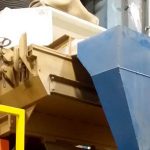
Sutton Gravity Seperators
Separation by Density, Size or Shape
Learn MoreOur founders, Sutton Steele & Steele, invented the first dry materials separation equipment, known today as “density or gravity separators, air tables or fluidized bed separators”. Originally developed and patented in 1919, the density separation is achieved with two components, mechanical vibration and air fluidization.
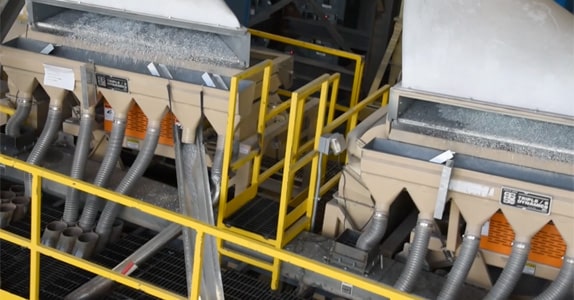
Today, Triple/S’ line of density separators and stoners are being used in thousands of applications, from cleaning of leafy spices and peppercorns to reclaiming copper from scrap wire and cable.
How is fluidizing air and controlled vibration used to separate a dry mixture? Using tuned airflow to stratify the material?
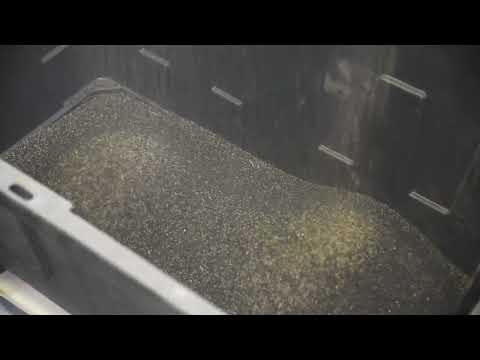
The lighter materials are lifted from the deck surface and allowed to float down the inclination of the deck. Heavier particles are in closer contact with an inclined vibrating surface. This vibration actually moved particles on the surface up the incline, opposite the lighter material not in contact with the vibration.
What is the most efficient way to accomplish dry material separation?
For efficient dry material separation you will want to screen the particles into manageable size ranges prior to separation. Where significant variations in shape are found to be detrimental to separation efficiency, size reduction or other process steps to change the shape may be added to reduce the range of variation. Moisture reduction may also be key to effective separation. Some materials absorb moisture and weight, others are complicated by the ‘sticky factor.’
What is the difference between the two-way seperator and the gravity separator?
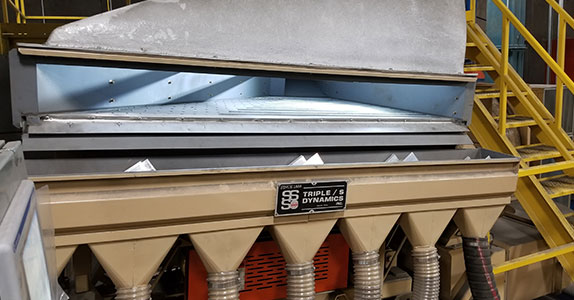
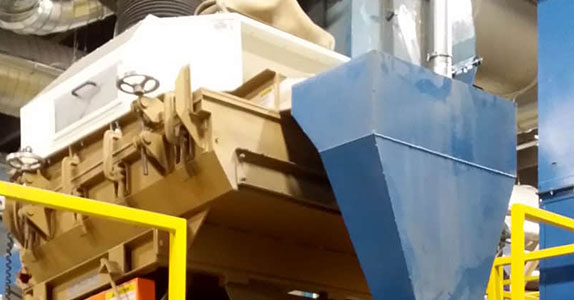
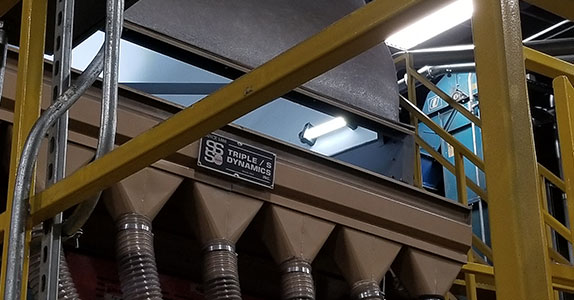
In general, there are two different model classifications, rectangular two-way separations and triangular offering a gradient of density out. The rectangular shape is commonly called a stoner. The triangular shape is commonly referred to as a gravity separator or air table.
When should I use a gravity separator?
The triangular shape, or trapezoidal, produces a fan or range of density output allowing one or more intermediate density fractions or “middlings.” In some processes, the middling fraction allows further separation efficiency by allowing other processes. This can be recycled intro further density separation.
When should I use a stoner?
It is used when separation of a smaller amount of dense material from a lighter product. The name is derived from separations of contaminants from agricultural products, but density separations cross into mineral, chemical and many other areas. A stoner may have a higher capacity and lower operator attention requirements, but offer less flexibility and precision.
How do I choose between a Gravity Separator and a Stoner?
The correct choice depends on your material characteristics and desired separation results.
What is the maximum capacity of a Stoner?
Capacity depends on product characteristics such as density difference, particle size, and particle shape. The maximum documented capacity of Triple/S Stoner models is 500 cubic feet per hour.
What is the maximum capacity of a Gravity Separator?
The maximum capacity of a gravity separator varies based on product properties. The maximum documented capacity of Triple/S Gravity Separator models is 200 cubic feet per hour.
Capacity also varies based on product properties. The maximum documented capacity of Triple/S Gravity Separator models is 200 cubic feet per hour.
Triple/S density separation equipment is designed to process particle sizes ranging from 250 microns up to 1 inches.
Does gravity separation equipment require auxiliary equipment?
In addition to user-supplied electrical power, gravity separation equipment requires a dust collection system provided by others. Depending on the model size, required airflow can be up to 15,000 CFM.
Please enter your information.